Category: Uncategorized

  • How to Spec a Custom Cowboy Hat Order: Sizes, Crown Shapes and Felt Grades

    How to Spec a Custom Cowboy Hat Order: Sizes, Crown Shapes and Felt Grades

    Ordering cowboy hats in quantity is a different exercise from buying one for yourself. You commit to a size run, a crown shape, a felt grade and a decoration method before anyone can try a hat on, and a wrong call on any one of those turns a bulk order into a box of hats nobody wants to wear. This walkthrough covers the four decisions that actually determine whether a custom order fits and looks right, in roughly the order a production team will ask you about them.

    Start with the size run, not the color

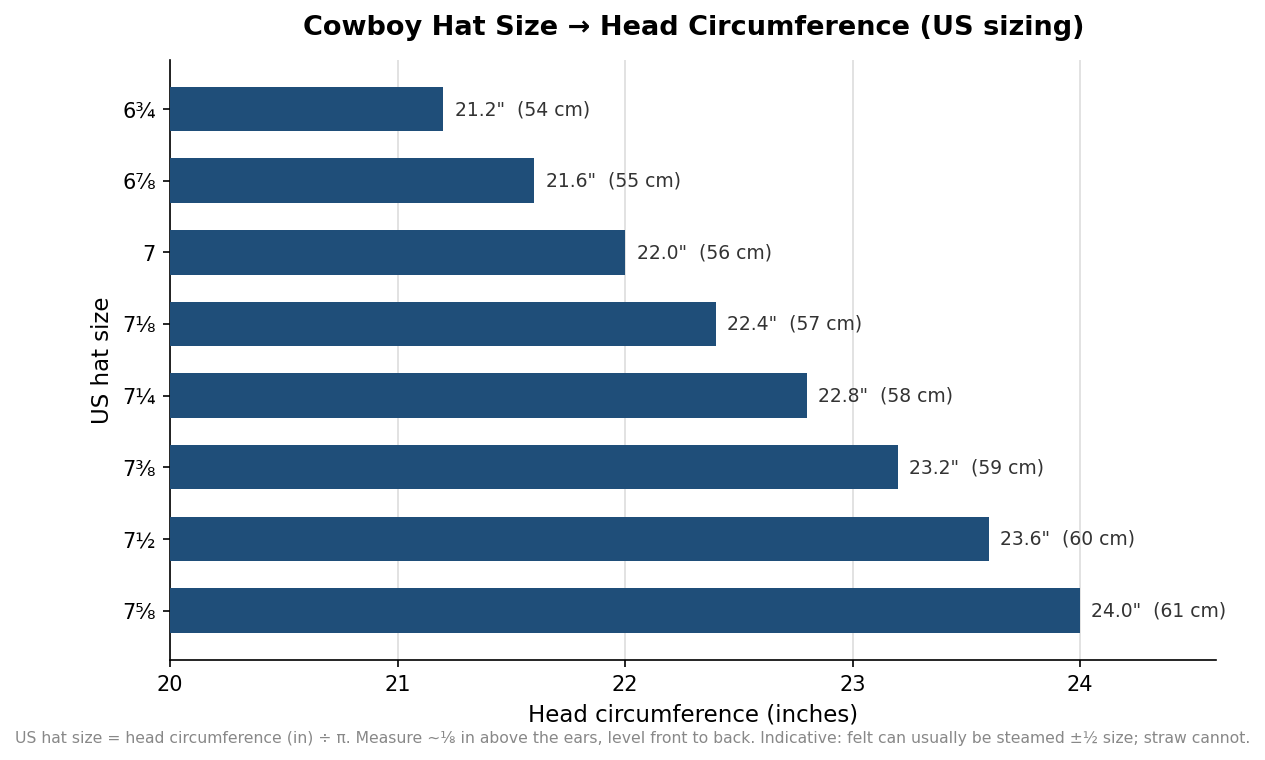
    Head size is where group hat orders go wrong most often. Measure with a soft tape around the head about an eighth of an inch above the ears and across the middle of the forehead, kept level front to back. That circumference maps directly to a US hat size, because the size number is just the circumference in inches divided by pi. So a 7 is a head of about 22 inches, a 7¼ is about 22.8 inches, and a 7½ is about 23.6 inches. Most adult heads are a “long oval” shape rather than a perfect circle, which is why a hat can measure right and still pinch front to back.

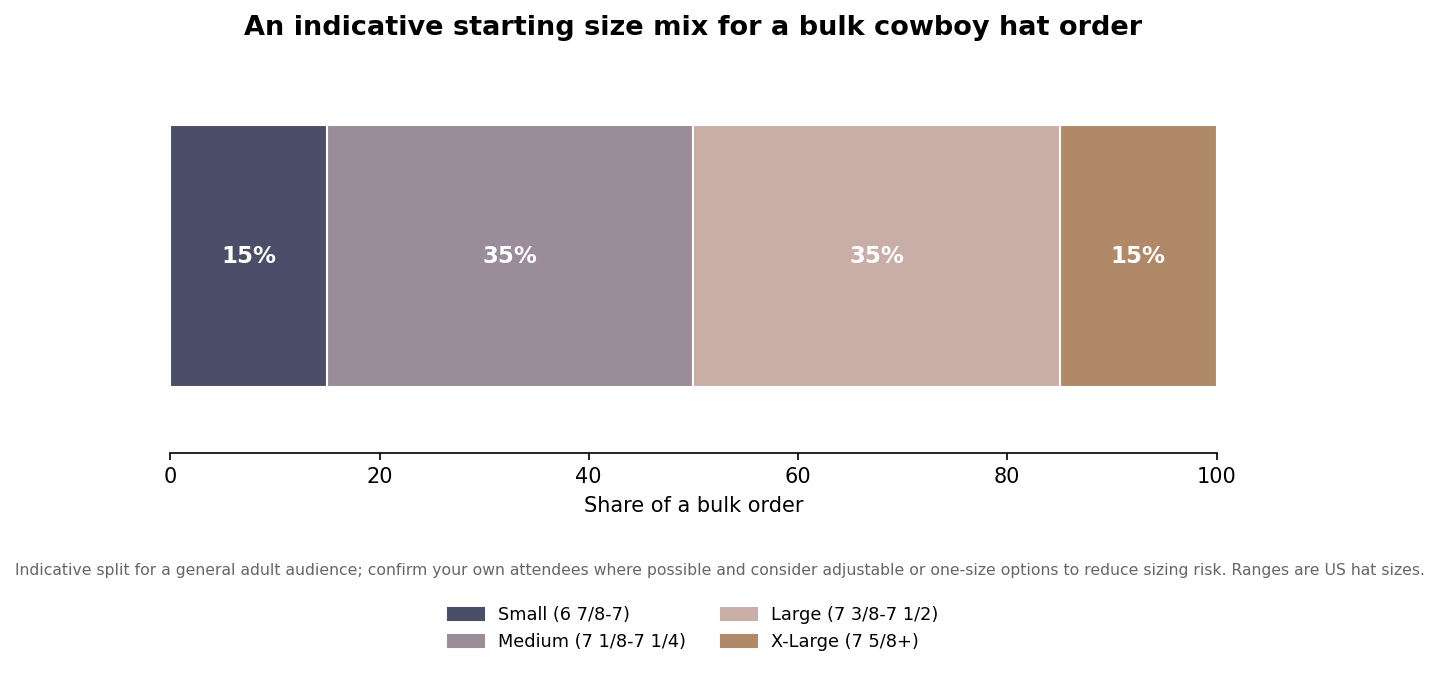
    When you cannot measure everyone in advance, weight the run toward the middle. In a typical mixed-adult group the 7 to 7⅜ band covers the majority of people, so order those sizes deep and the tails at 6¾ and 7⅝ light. Treat that as an indicative starting point, not a substitute for real measurements. An adjustable sizing tape or an elastic sweatband is a useful hedge for giveaway hats where an exact fit per person is impossible.

    Horizontal bar chart mapping US cowboy hat sizes from 6 3/4 to 7 5/8 to head circumference in inches and centimeters
    US hat size is simply head circumference in inches divided by pi.

    Crown crease and brim width set the look

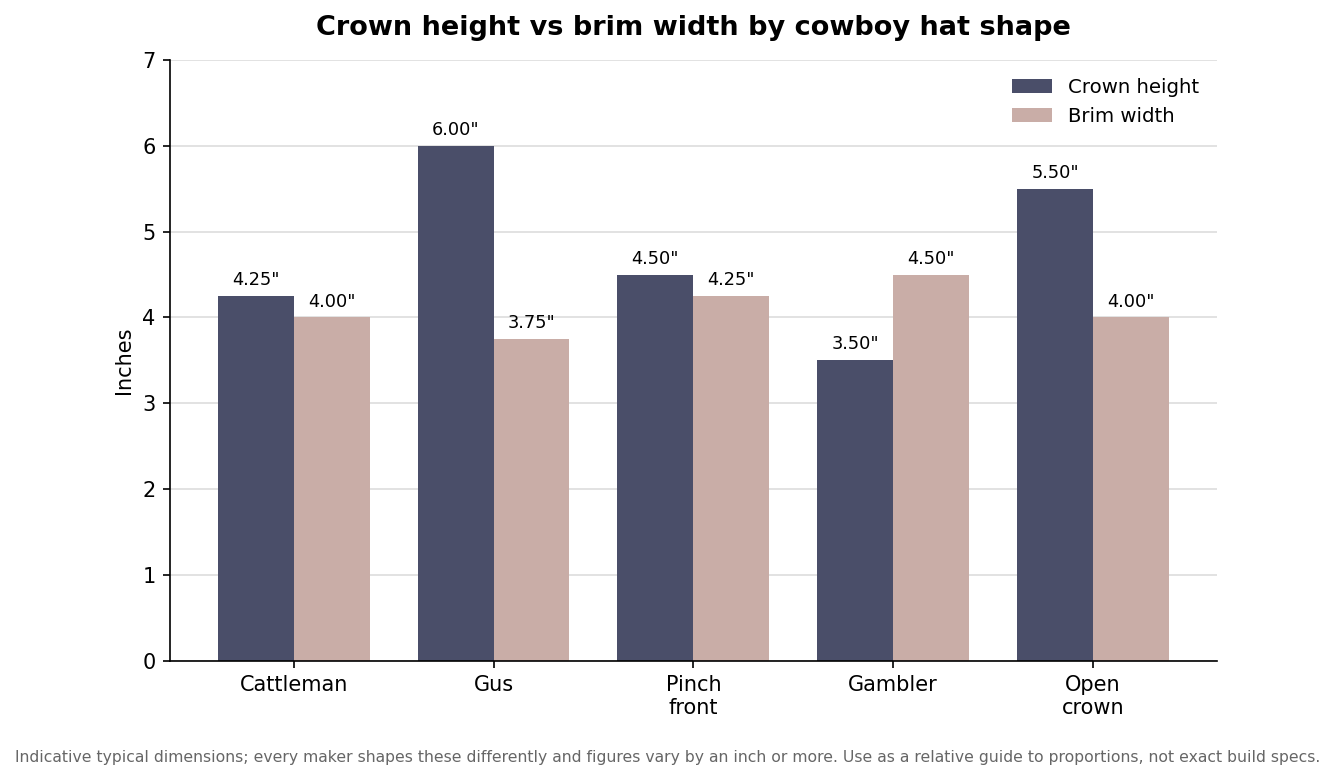
    The crown crease is what makes a hat read as classic, rugged or dressy. The cattleman is the default: a center crease with two side dents and a moderate crown around 4.25 to 4.5 inches, flattering on most faces and unmistakably western. The Gus has a sloped, tapered crown front to back and reads as a working-rancher hat. The gambler carries a rounded, oval crown and often a wider brim for a dressier feel. A cutter runs a taller crown near 5 inches for a bold, dramatic silhouette, while a pinch front or brick crease is more casual and urban. An open crown ships with no crease at all, which lets a hat shaper add a custom crease later or lets you keep a flat, uniform canvas.

    Brim width changes both the look and the logistics. Everyday brims land around 3.75 to 4.25 inches; sun and ranch work push wider than 4.25 inches; dress and city styles trim back to 2.5 to 3 inches. Wider brims photograph bolder but pack bulkier, cost more to ship, and catch wind at outdoor events. For branded and event hats, a clean cattleman or an open crown gives the flattest, most predictable surface for a band or a front patch.

    What the felt grade (the “X”) actually means

    The X rating is not a standard you can compare across suppliers. It once referred loosely to beaver-fur content, but today each maker sets its own scale, so a 10X from one company is not the same hat as a 10X from another. Read the X as a within-brand quality ladder and look at the material underneath instead. Wool felt is the entry point: stiffer, less weather resistant, the cheapest, and perfectly good for taking a logo. Fur felt, made from rabbit or hare and sometimes a beaver blend, is lighter, holds its shape better, sheds water more readily, and costs more. Straw hats also use an X figure, but there it describes weave tightness, where higher numbers mean a finer, denser weave.

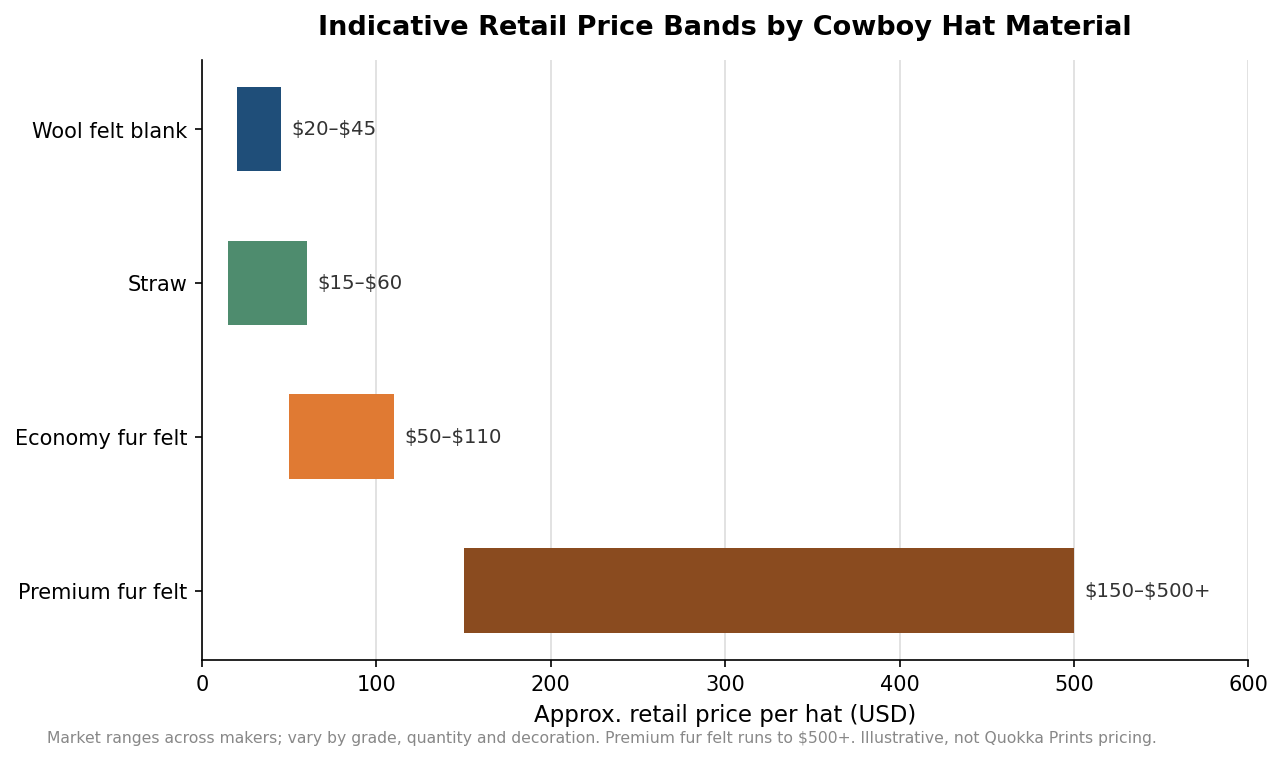
    For custom and branded runs, most buyers settle on wool felt or an economy fur felt, because the hat is functioning as a canvas for a logo rather than as an heirloom. The price bands below are broad market ranges to set expectations; actual quotes move with grade, quantity and decoration, and they are not Quokka Prints figures.

    Floating bar chart of indicative retail price ranges for wool felt, straw, economy fur felt and premium fur felt cowboy hats
    Indicative market price bands by material; premium fur felt runs to $500 and above.

    Decoration decides which blank you can use

    Where the logo goes quietly constrains which blank makes sense. A leather patch on the front crown, embossed or laser-engraved, is the most popular choice for events, and it wants a crown with enough flat front area, which is why cattleman and open-crown hats are the usual pick. A custom hat band in woven fabric, printed ribbon or leather with a buckle or concho is non-permanent, easy to swap between events, and never touches the felt. Embroidery generally lands on the band or on a separate patch rather than directly on the crown. Small pins and conchos read as subtle accents. Keep contrast in mind: dark felt hides dark thread, while a light patch pops against a dark crown.

    Turn it into a spec sheet

    Pull the decisions into one line each: quantity and size run, material and grade, color, crown crease, brim width, decoration method and placement, artwork format, and your in-hand date. In-stock blanks typically decorate in roughly one to three weeks depending on method and quantity, while custom-dyed or special-order felt adds time on top of that. On any large order, ask for a pre-production sample and confirm your artwork is supplied as vector before the run starts. That single sheet is what lets a maker quote accurately without a dozen back-and-forth emails, and it is the difference between a smooth reorder and a surprise.

  • How to Put Your Logo on a Cowboy Hat: Branding Methods Compared

    How to Put Your Logo on a Cowboy Hat: Branding Methods Compared

    A cowboy hat is a big, uninterrupted canvas that people actually look at, which makes it a genuinely good place to put a logo, and also an easy place to put one badly. The mark can be stitched, stamped, etched, molded, or printed onto a band, and each of those routes changes how the hat looks up close, how long the branding lasts through weather and handling, and how much of your logo’s detail actually survives. If you are ordering branded hats for a ranch brand, a distillery, a festival, or a corporate western event, the decoration method deserves as much thought as the felt or straw underneath it. Here is how the options really differ and how to match one to your logo.

    The leather patch, and why the stamping method matters

    A leather patch is the default premium look on a felt cowboy hat, and buyers often stop there without realizing that how the logo is put into the leather changes everything. Heat-stamping presses the design into the hide, creating a true three-dimensional impression with crisp, clean edges you can feel. Because the compressed leather fibers end up denser than the surrounding material, a stamped mark does not fade, peel, or wear away; it tends to look better with age. The catch is that stamping favors bold linework and solid shapes and struggles with anything finer than about half a millimeter, so intricate logos usually need simplifying.

    Laser etching takes the opposite trade. It vaporizes a shallow layer off the leather’s surface, which lets it render finer detail and small type that a stamp would blur, but the result is flat rather than dimensional, the edges can look slightly scorched or discolored, and the etched surface is thinner than the leather around it, so it can smooth out or fade with heavy wear. Neither is simply better. A bold, chunky brand mark belongs on a heat stamp; a detailed crest or fine wordmark is a candidate for laser etching, with the understanding that it trades some longevity for that detail.

    Embroidered and woven patches: thread versus fine detail

    Embroidery is the most traditionally western decoration after leather, and a stitched patch reads as authentic on felt while standing up well to years of use. Its limit is resolution. Thread is a relatively coarse medium, so small text and thin lines fill in or drop out, and color is limited to the thread palette rather than a smooth photographic range. Woven patches solve the detail problem by using much finer threads on a tighter loom, holding small type and crisp edges that embroidery cannot, at the cost of a flatter, less tactile surface that looks a little more corporate and a little less ranch.

    Both patch types are usually sewn onto the hat, and for headwear that matters: a stitched patch stays put through weather and handling far better than one that is only heat-pressed on, which can lift at the edges over time. If a supplier offers a press-on option to save money, weigh that against how hard the hat will be used.

    PVC patches and printed hat bands: color and weather

    When a logo needs full, vivid color or has to shrug off rain, a molded PVC or rubber patch earns its place. The color is built into the material so it stays bright, it is effectively waterproof, and it handles gradients and multiple colors that thread cannot. The trade is aesthetic: a rubber patch reads modern and streetwear rather than classic western, which suits a festival or a lifestyle brand more than a heritage ranch. The printed hat band is the other underused surface, and it is often the smartest choice on straw promotional hats, where a full-color imprinted band carries the brand cleanly without touching the crown. A band can hold fine detail and many colors, though it brands the ribbon rather than the hat itself, so it lives or dies with the band staying on.

    Matching the method to the hat and the logo

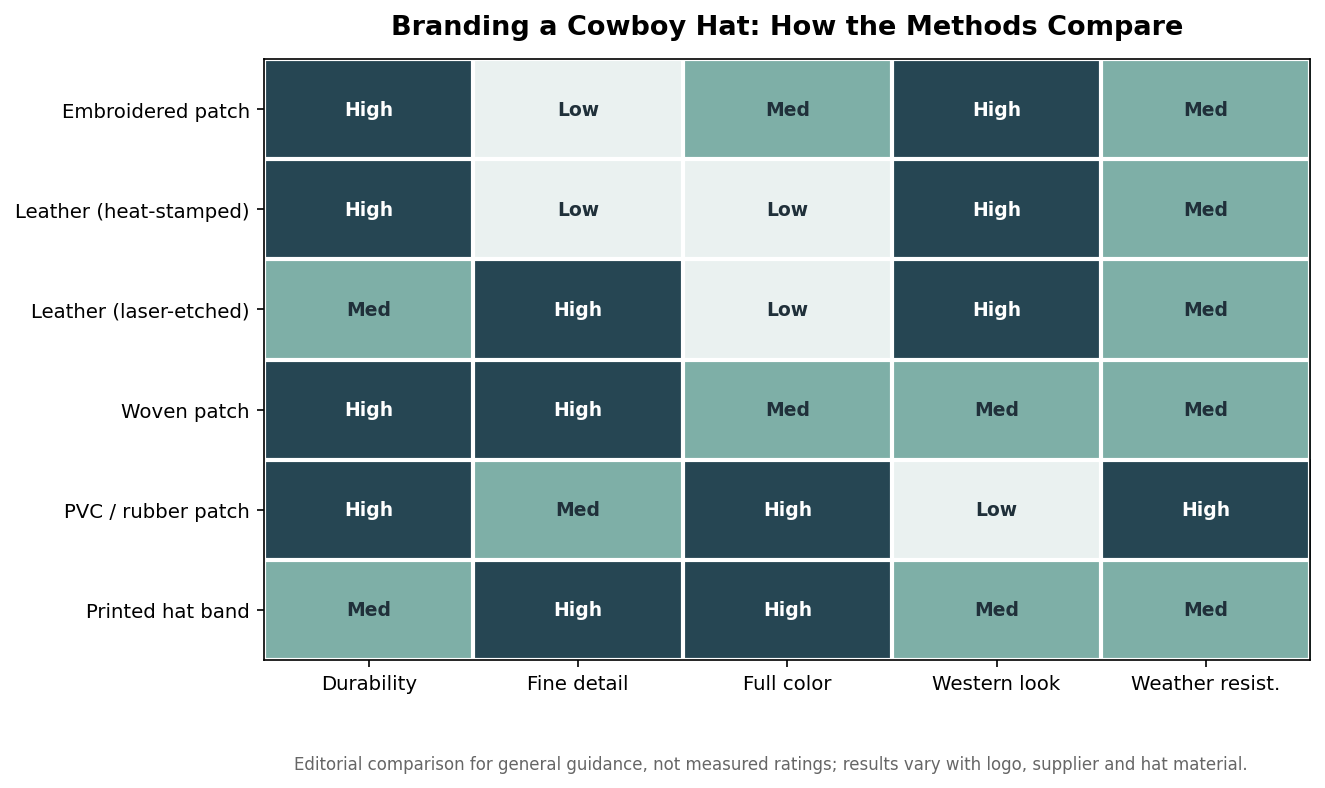
    The decision is really a matter of lining up three things: the hat material, the look you want, and the logo you have. Felt crowns pair naturally with leather patches and embroidery; straw promotional hats lean toward printed bands; a weatherproof outdoor giveaway points at PVC. The comparison below sketches how the common methods stack up on the attributes buyers ask about most.

    Editorial heatmap comparing embroidered, leather heat-stamped, leather laser, woven, PVC, and printed-band cowboy hat branding across durability, detail, color, western look and weather resistance
    How the common branding methods compare on the attributes buyers ask about most (editorial guidance, not measured ratings).

    Read that as general guidance rather than a scorecard, because the right answer shifts with your specific logo and supplier. A heritage brand that values a timeless, tactile look will accept embroidery’s coarser detail to get the western feel; a tech-forward sponsor that needs its exact gradient will accept a rubber patch’s modern look to get the color. Name the two attributes you care about most and the field narrows fast.

    Designing a logo that survives the method

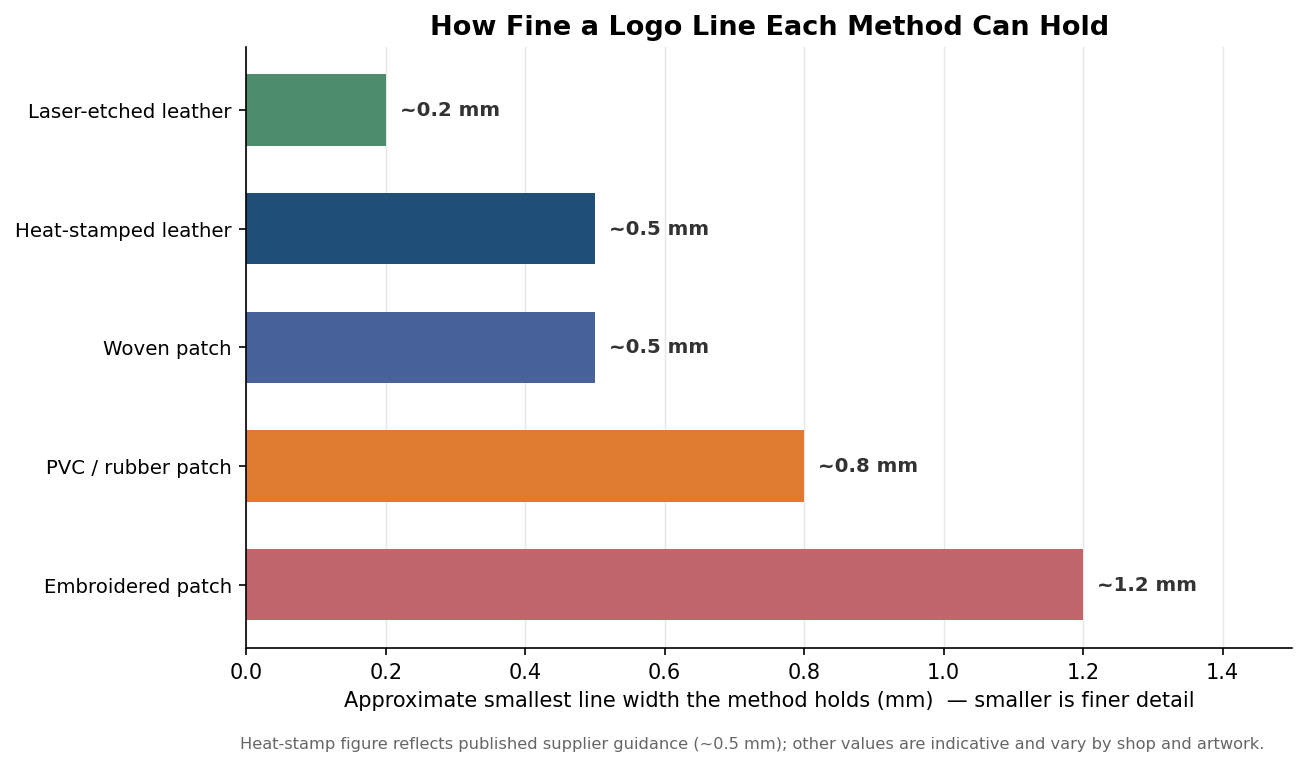
    Whichever route you choose, the artwork has to respect the medium’s resolution, and this is where most branded-hat orders go wrong. Every method has a smallest line it can hold, and pushing below it turns a sharp logo into mush. Heat-stamped leather and embroidery are the coarsest and want bold, simplified art; laser etching and woven patches hold much finer detail; printed bands are the most forgiving of small type. The figure below shows roughly where each method lands.

    Horizontal bar chart of the approximate smallest line width each cowboy hat branding method can hold, from laser leather at 0.2mm to embroidery at 1.2mm
    Roughly how fine a line each method holds; coarser methods need bolder, simplified artwork.

    Treat those numbers as planning guidance rather than hard limits, since the real threshold depends on the shop and the artwork, and confirm the smallest usable size with your supplier before approving a proof. In practice the fix is simple: supply clean vector art, thicken hairline strokes, and if a tagline is too small to reproduce at the size the method allows, drop it rather than let it print as a smudge. Choose the method for the hat and the look, size the logo to what that method can hold, and a branded cowboy hat becomes exactly the kind of piece people keep and wear long after the event that handed it to them.

  • Felt vs. Straw vs. Leather Cowboy Hats: A Materials and Grades Guide

    Felt vs. Straw vs. Leather Cowboy Hats: A Materials and Grades Guide

    Felt, straw, and leather are not three versions of the same hat. They are three different products with different seasons, price ceilings, and ways of taking a logo. If you are ordering cowboy hats to brand for a rodeo sponsorship, a country music festival, a wedding party, or a western retail line, the material decision drives almost everything downstream: what it costs, how it wears, and which decoration methods are even possible. This guide walks through what separates the three, what the confusing X ratings on felt actually mean, and how each material takes branding.

    The three materials and what each is for

    Felt is the cool-weather hat. Made from pressed animal fiber, felt holds a crisp shape, sheds light rain, and reads as the dressier, more traditional option. It is what most people picture as a “real” cowboy hat, and it spans an enormous quality and price range depending on the fiber blend. Straw is the warm-weather counterpart: woven rather than pressed, breathable, lighter, and priced lower at the entry level, which makes it the workhorse for summer events and outdoor giveaways. Leather sits apart from both. A leather cowboy hat is soft, casual, and rugged rather than formal, and it appeals to buyers who want a distinctive look that shrugs off handling, though it does not hold a sharp crease the way felt does.

    Season is the first filter. A felt hat handed out at an August festival will bake the wearer; a straw hat at a December event looks out of place. If your run has to work year round, that usually points to ordering both a felt and a straw option rather than forcing one material to cover every date.

    Decoding the X: what felt grades actually mean

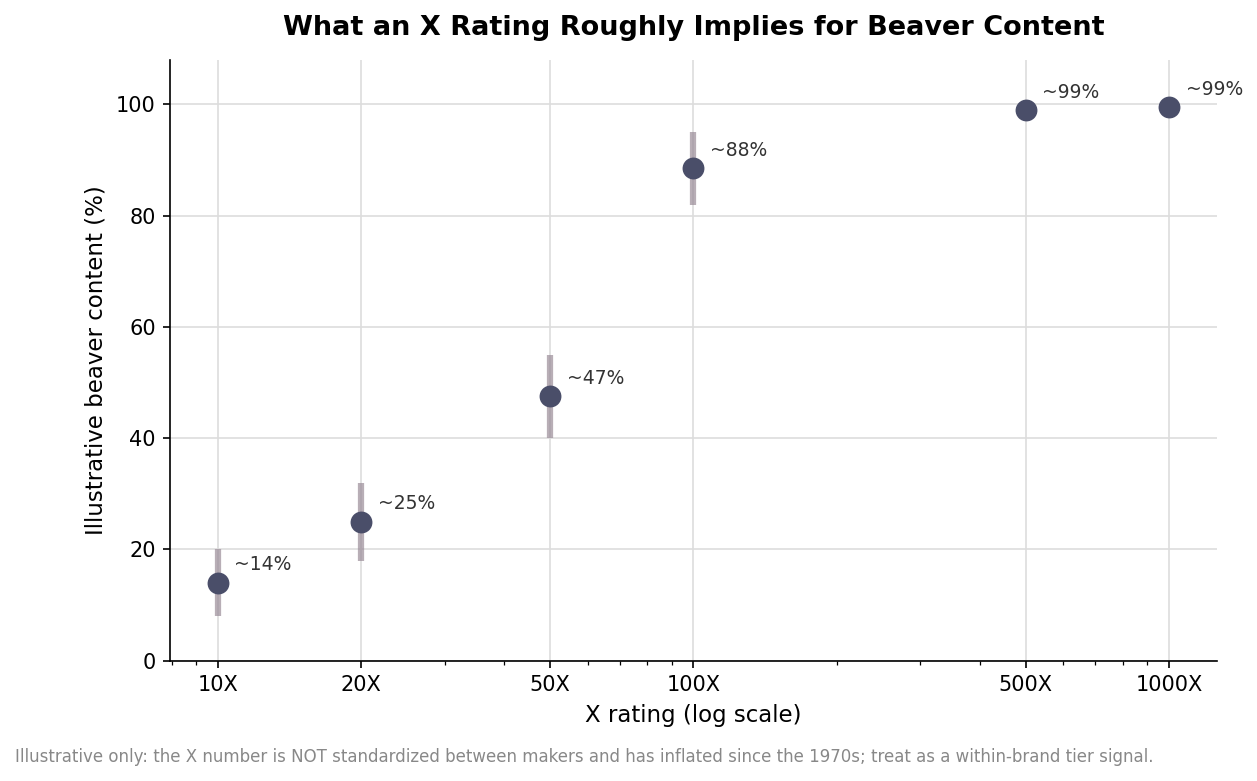
    The single most misunderstood number in western hats is the X rating stamped inside the sweatband. Historically it was a real measurement: a 10X hat once meant essentially pure beaver felt, prized because beaver fiber has microscopic hooked barbs that interlock into a dense, water-shedding, shape-holding material. Since the 1970s, though, the X scale has inflated and drifted. Makers quietly reduced beaver content while keeping or raising the X number, and because no governing body standardizes the scale, every brand now speaks its own dialect. A modern 50X from one maker can carry roughly 40 to 55 percent beaver, a 100X often lands in the mid-80s to mid-90s, and only the top of a brand’s line reaches genuinely pure beaver or beaver blended with exotic fur.

    Scatter chart with range whiskers showing illustrative beaver content rising with X rating, from about 14% at 10X to near 100% at 500X and above
    An illustrative read on X ratings; the X number is not standardized between makers, so treat it as a within-brand tier.

    The practical takeaway is to read the X as a within-brand tier signal, not a cross-brand spec. A 20X in one company’s catalog and a 20X in another’s are not guaranteed to be the same felt. Wool felt, the entry point, is a different animal entirely: it is porous, less water resistant, and usually sold either unrated or at a low X, and it is the right call for a high-volume promotional order where the hat is a keepsake rather than a decade-long daily wear. When comparing quotes, ask the supplier for the actual fiber content, because that number tells you far more than the X on the band.

    Straw grades and why the weave matters

    Straw has its own quality ladder, and it is easier to read than felt because you can see and feel it. Tighter, finer weaves take more labor and cost more, and they hold their shape better in heat and humidity. Premium straws such as Shantung and genuine palm sit well above basic paper or toyo straw in both durability and price, with the finest hats woven from very high grass counts. For a branded order, the decision is usually between a low-cost open-weave straw that photographs well and survives a single event, and a tighter premium weave that a recipient will actually keep and wear. The former maximizes reach per dollar; the latter maximizes goodwill and lifespan. Neither is wrong, but they serve different campaign goals.

    What it costs, by material and grade

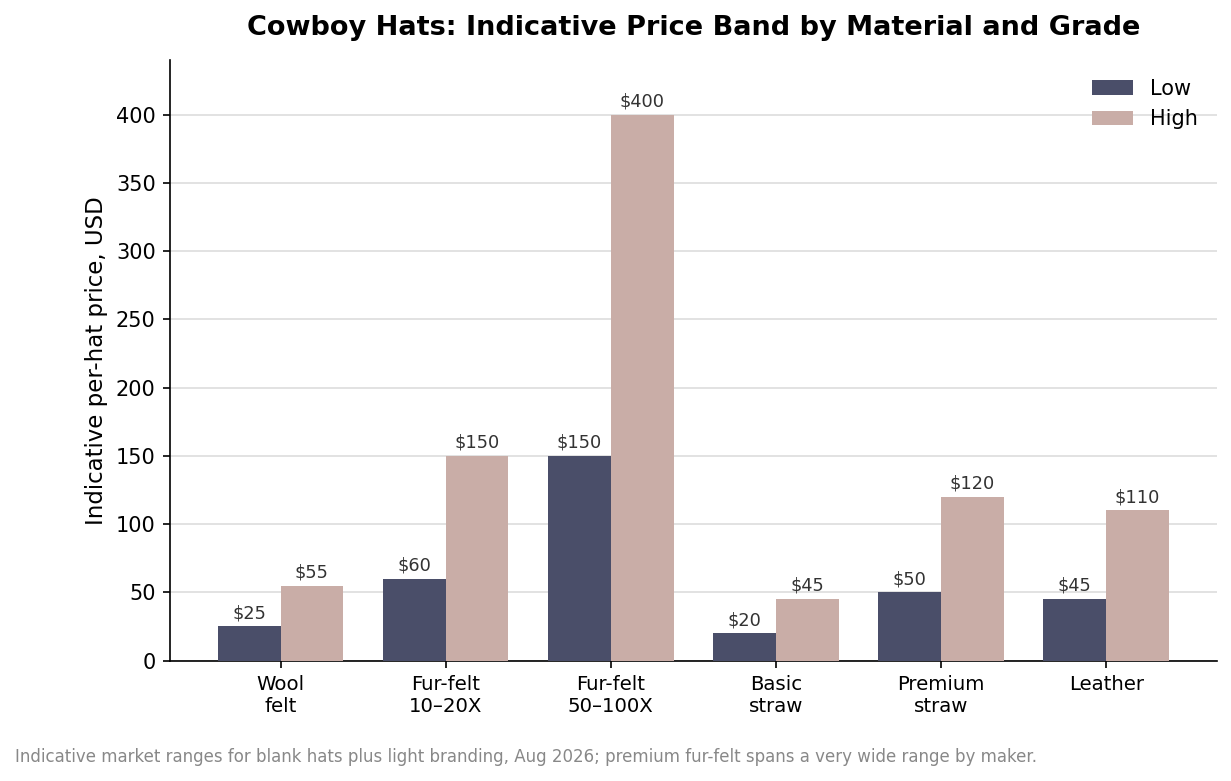
    Price tracks material and grade more than anything else, and the spread is dramatic. A basic straw or wool-felt hat suitable for a giveaway can land in the low tens of dollars per unit, while a premium fur-felt in the 100X range and up climbs into the hundreds. Leather generally slots in the mid-range, above basic straw and wool felt but below serious fur-felt. The chart below shows indicative bands; treat them as directional market ranges rather than quotes, because grade, quantity, and decoration each move the number.

    Grouped bar chart of indicative low and high cowboy hat prices by material and grade, from basic straw at $20-45 to premium fur-felt at $150-400
    Indicative price bands by material and grade; premium fur-felt spans a very wide range by maker.

    The reason the premium fur-felt bar is so wide is the same X-rating fuzziness described above: two hats both labeled high-X can differ in real fiber content and therefore in real cost. For budgeting a branded run, decide the tier first based on how the hat will be used, then compare fiber content within that tier, and only then weigh quantity discounts.

    Branding a cowboy hat: methods that suit the material

    Cowboy hats do not take a logo the way a baseball cap does, because you cannot simply run a curved felt or straw crown through a flat embroidery machine. The most common branding routes are a leather patch, a custom hat band, and applied hardware. A laser-engraved or debossed leather patch attaches to the front of the crown and works across felt, straw, and leather alike, giving a clean logo surface without fighting the hat’s texture. A printed, woven, or tooled hat band wraps the crown and carries a repeating logo or team colors, and it is often the most cost-effective option at volume because it decorates without touching the hat body. Applied pieces such as conchos, pins, and feathers add a premium, collectible feel for higher-end gifts.

    Two material-specific cautions matter. Felt can be heat-branded for a subtle tonal mark, but aggressive heat scorches, so it belongs in experienced hands. Straw’s open weave will not hold fine embroidery or small print, which is why patches and bands dominate there. Whatever the method, send layered vector artwork and confirm the patch or band size against the crown before committing a bulk run, since a logo sized for a cap will look lost on a ten-gallon crown. Match the decoration to the material and the hat carries your brand without ever looking like an afterthought.