A cowboy hat is a big, uninterrupted canvas that people actually look at, which makes it a genuinely good place to put a logo, and also an easy place to put one badly. The mark can be stitched, stamped, etched, molded, or printed onto a band, and each of those routes changes how the hat looks up close, how long the branding lasts through weather and handling, and how much of your logo’s detail actually survives. If you are ordering branded hats for a ranch brand, a distillery, a festival, or a corporate western event, the decoration method deserves as much thought as the felt or straw underneath it. Here is how the options really differ and how to match one to your logo.
The leather patch, and why the stamping method matters
A leather patch is the default premium look on a felt cowboy hat, and buyers often stop there without realizing that how the logo is put into the leather changes everything. Heat-stamping presses the design into the hide, creating a true three-dimensional impression with crisp, clean edges you can feel. Because the compressed leather fibers end up denser than the surrounding material, a stamped mark does not fade, peel, or wear away; it tends to look better with age. The catch is that stamping favors bold linework and solid shapes and struggles with anything finer than about half a millimeter, so intricate logos usually need simplifying.
Laser etching takes the opposite trade. It vaporizes a shallow layer off the leather’s surface, which lets it render finer detail and small type that a stamp would blur, but the result is flat rather than dimensional, the edges can look slightly scorched or discolored, and the etched surface is thinner than the leather around it, so it can smooth out or fade with heavy wear. Neither is simply better. A bold, chunky brand mark belongs on a heat stamp; a detailed crest or fine wordmark is a candidate for laser etching, with the understanding that it trades some longevity for that detail.
Embroidered and woven patches: thread versus fine detail
Embroidery is the most traditionally western decoration after leather, and a stitched patch reads as authentic on felt while standing up well to years of use. Its limit is resolution. Thread is a relatively coarse medium, so small text and thin lines fill in or drop out, and color is limited to the thread palette rather than a smooth photographic range. Woven patches solve the detail problem by using much finer threads on a tighter loom, holding small type and crisp edges that embroidery cannot, at the cost of a flatter, less tactile surface that looks a little more corporate and a little less ranch.
Both patch types are usually sewn onto the hat, and for headwear that matters: a stitched patch stays put through weather and handling far better than one that is only heat-pressed on, which can lift at the edges over time. If a supplier offers a press-on option to save money, weigh that against how hard the hat will be used.
PVC patches and printed hat bands: color and weather
When a logo needs full, vivid color or has to shrug off rain, a molded PVC or rubber patch earns its place. The color is built into the material so it stays bright, it is effectively waterproof, and it handles gradients and multiple colors that thread cannot. The trade is aesthetic: a rubber patch reads modern and streetwear rather than classic western, which suits a festival or a lifestyle brand more than a heritage ranch. The printed hat band is the other underused surface, and it is often the smartest choice on straw promotional hats, where a full-color imprinted band carries the brand cleanly without touching the crown. A band can hold fine detail and many colors, though it brands the ribbon rather than the hat itself, so it lives or dies with the band staying on.
Matching the method to the hat and the logo
The decision is really a matter of lining up three things: the hat material, the look you want, and the logo you have. Felt crowns pair naturally with leather patches and embroidery; straw promotional hats lean toward printed bands; a weatherproof outdoor giveaway points at PVC. The comparison below sketches how the common methods stack up on the attributes buyers ask about most.
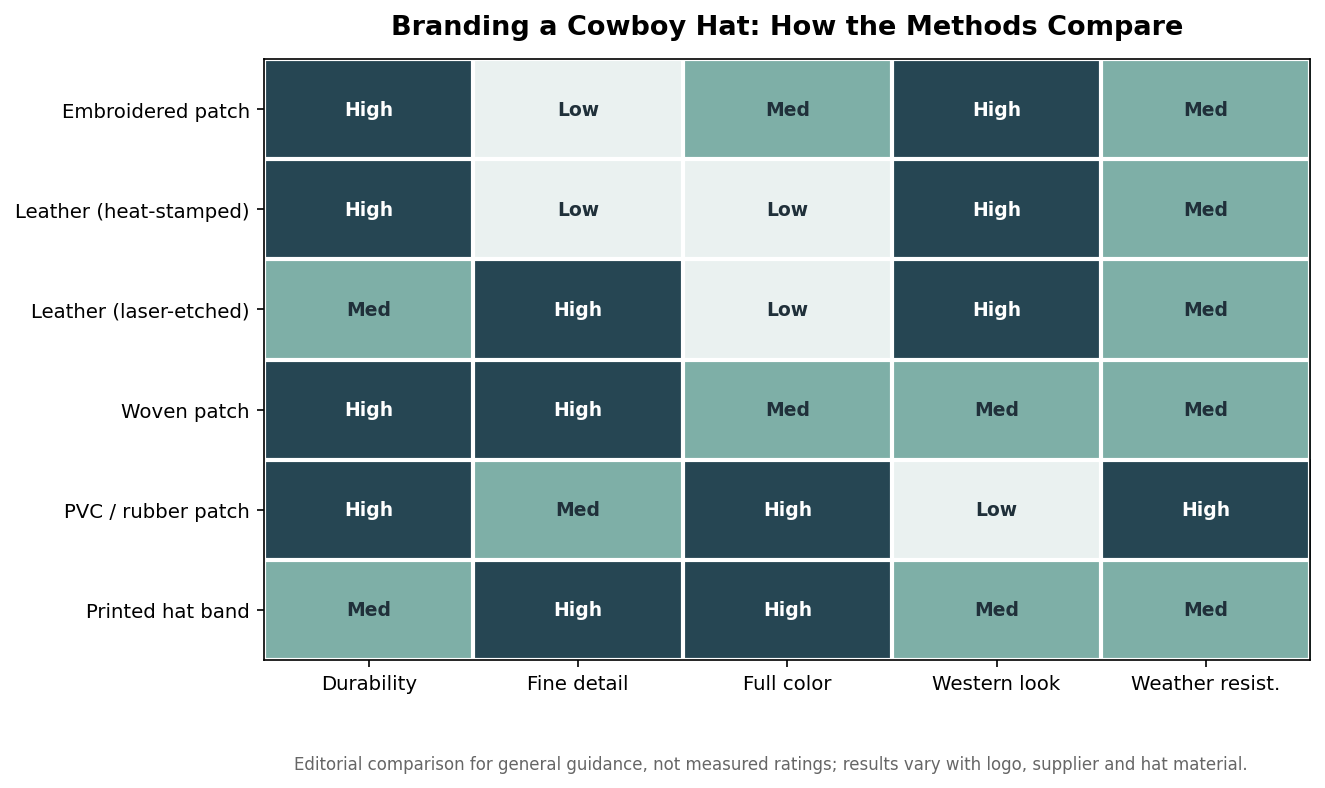
Read that as general guidance rather than a scorecard, because the right answer shifts with your specific logo and supplier. A heritage brand that values a timeless, tactile look will accept embroidery’s coarser detail to get the western feel; a tech-forward sponsor that needs its exact gradient will accept a rubber patch’s modern look to get the color. Name the two attributes you care about most and the field narrows fast.
Designing a logo that survives the method
Whichever route you choose, the artwork has to respect the medium’s resolution, and this is where most branded-hat orders go wrong. Every method has a smallest line it can hold, and pushing below it turns a sharp logo into mush. Heat-stamped leather and embroidery are the coarsest and want bold, simplified art; laser etching and woven patches hold much finer detail; printed bands are the most forgiving of small type. The figure below shows roughly where each method lands.
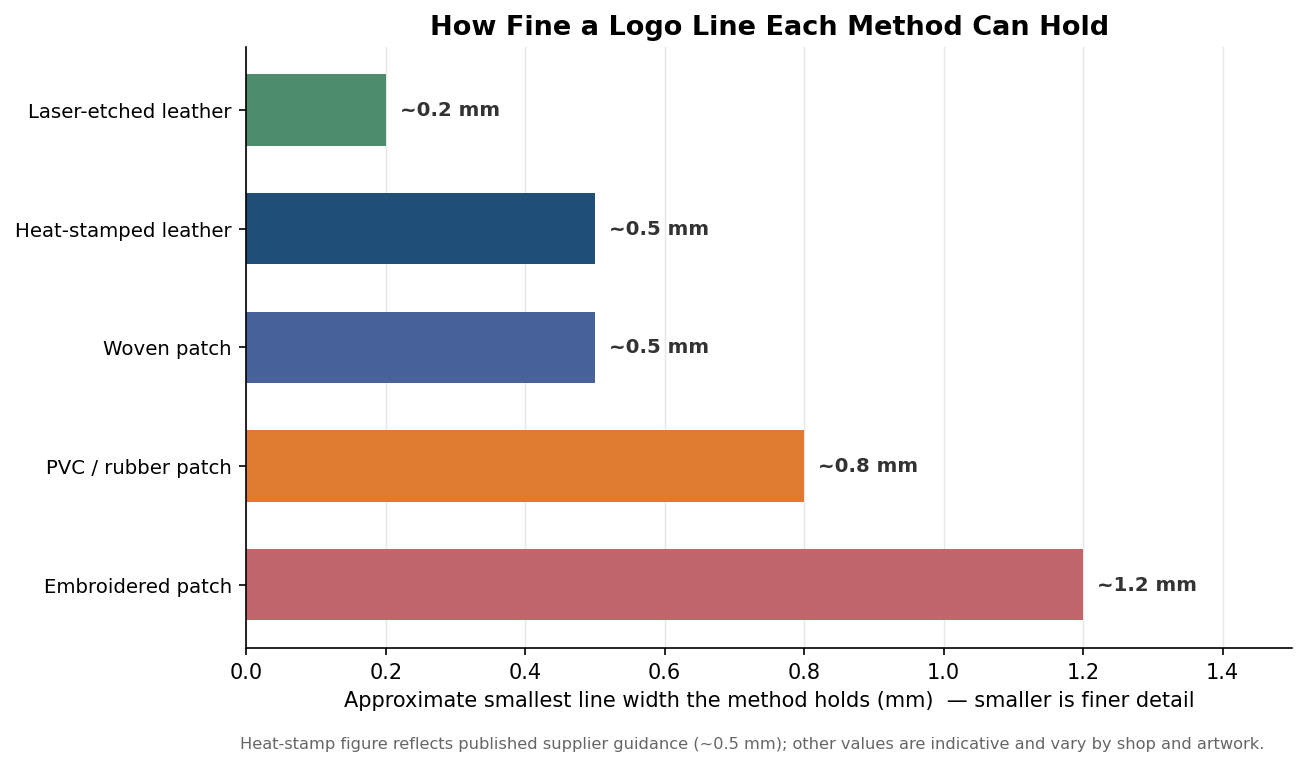
Treat those numbers as planning guidance rather than hard limits, since the real threshold depends on the shop and the artwork, and confirm the smallest usable size with your supplier before approving a proof. In practice the fix is simple: supply clean vector art, thicken hairline strokes, and if a tagline is too small to reproduce at the size the method allows, drop it rather than let it print as a smudge. Choose the method for the hat and the look, size the logo to what that method can hold, and a branded cowboy hat becomes exactly the kind of piece people keep and wear long after the event that handed it to them.
Leave a Reply