Ordering cowboy hats in quantity is a different exercise from buying one for yourself. You commit to a size run, a crown shape, a felt grade and a decoration method before anyone can try a hat on, and a wrong call on any one of those turns a bulk order into a box of hats nobody wants to wear. This walkthrough covers the four decisions that actually determine whether a custom order fits and looks right, in roughly the order a production team will ask you about them.
Start with the size run, not the color
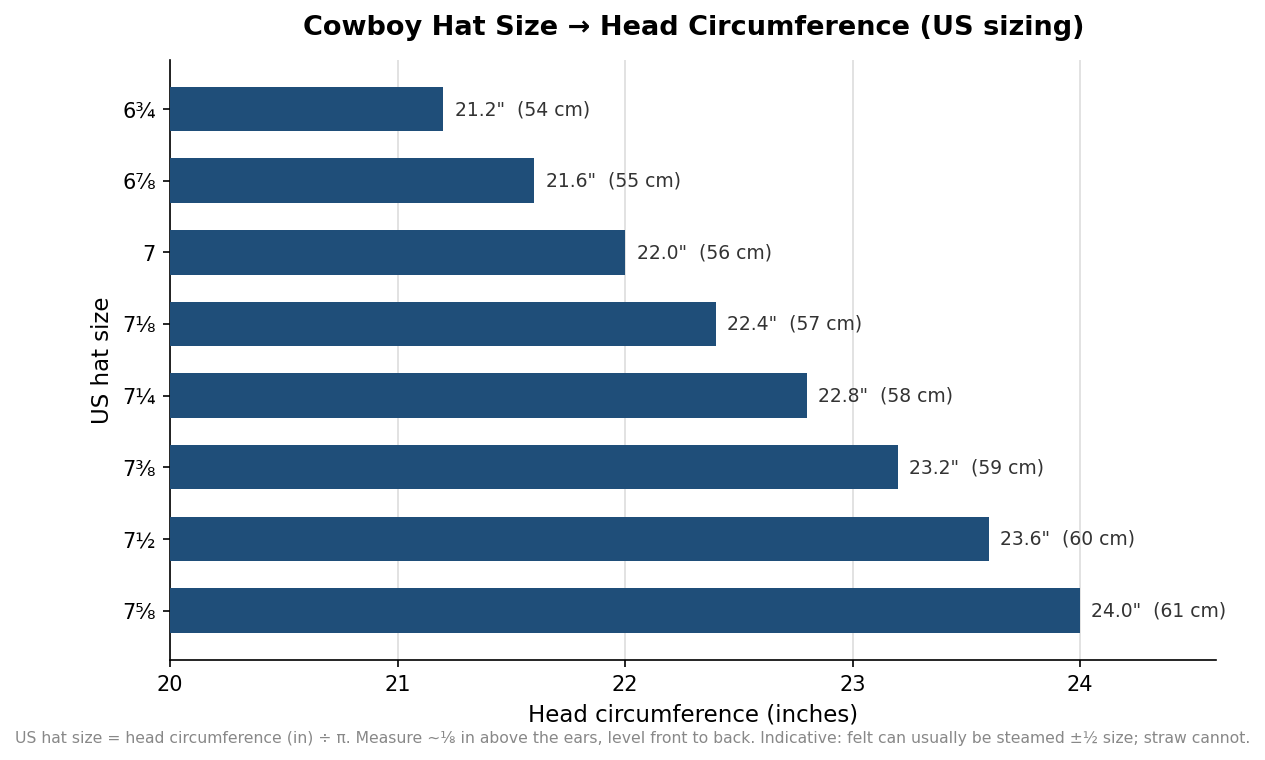
Head size is where group hat orders go wrong most often. Measure with a soft tape around the head about an eighth of an inch above the ears and across the middle of the forehead, kept level front to back. That circumference maps directly to a US hat size, because the size number is just the circumference in inches divided by pi. So a 7 is a head of about 22 inches, a 7¼ is about 22.8 inches, and a 7½ is about 23.6 inches. Most adult heads are a “long oval” shape rather than a perfect circle, which is why a hat can measure right and still pinch front to back.
When you cannot measure everyone in advance, weight the run toward the middle. In a typical mixed-adult group the 7 to 7⅜ band covers the majority of people, so order those sizes deep and the tails at 6¾ and 7⅝ light. Treat that as an indicative starting point, not a substitute for real measurements. An adjustable sizing tape or an elastic sweatband is a useful hedge for giveaway hats where an exact fit per person is impossible.
Crown crease and brim width set the look
The crown crease is what makes a hat read as classic, rugged or dressy. The cattleman is the default: a center crease with two side dents and a moderate crown around 4.25 to 4.5 inches, flattering on most faces and unmistakably western. The Gus has a sloped, tapered crown front to back and reads as a working-rancher hat. The gambler carries a rounded, oval crown and often a wider brim for a dressier feel. A cutter runs a taller crown near 5 inches for a bold, dramatic silhouette, while a pinch front or brick crease is more casual and urban. An open crown ships with no crease at all, which lets a hat shaper add a custom crease later or lets you keep a flat, uniform canvas.
Brim width changes both the look and the logistics. Everyday brims land around 3.75 to 4.25 inches; sun and ranch work push wider than 4.25 inches; dress and city styles trim back to 2.5 to 3 inches. Wider brims photograph bolder but pack bulkier, cost more to ship, and catch wind at outdoor events. For branded and event hats, a clean cattleman or an open crown gives the flattest, most predictable surface for a band or a front patch.
What the felt grade (the “X”) actually means
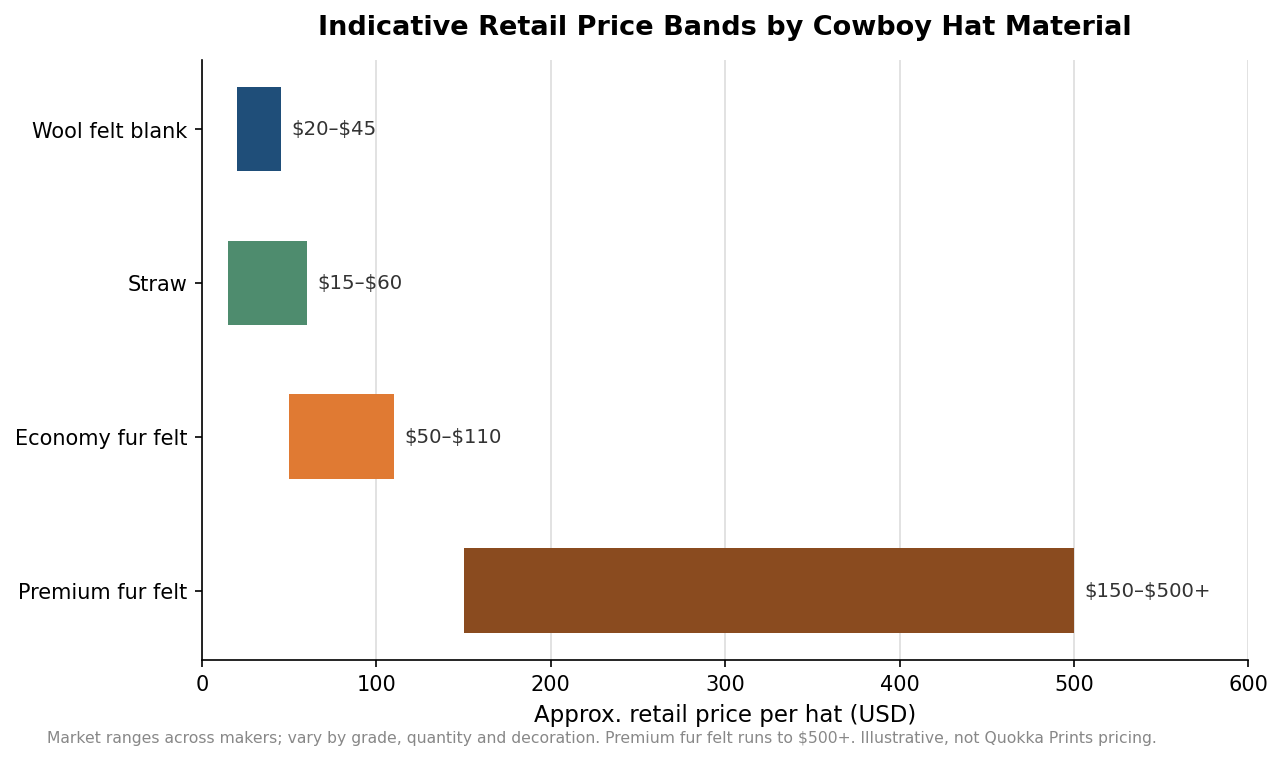
The X rating is not a standard you can compare across suppliers. It once referred loosely to beaver-fur content, but today each maker sets its own scale, so a 10X from one company is not the same hat as a 10X from another. Read the X as a within-brand quality ladder and look at the material underneath instead. Wool felt is the entry point: stiffer, less weather resistant, the cheapest, and perfectly good for taking a logo. Fur felt, made from rabbit or hare and sometimes a beaver blend, is lighter, holds its shape better, sheds water more readily, and costs more. Straw hats also use an X figure, but there it describes weave tightness, where higher numbers mean a finer, denser weave.
For custom and branded runs, most buyers settle on wool felt or an economy fur felt, because the hat is functioning as a canvas for a logo rather than as an heirloom. The price bands below are broad market ranges to set expectations; actual quotes move with grade, quantity and decoration, and they are not Quokka Prints figures.
Decoration decides which blank you can use
Where the logo goes quietly constrains which blank makes sense. A leather patch on the front crown, embossed or laser-engraved, is the most popular choice for events, and it wants a crown with enough flat front area, which is why cattleman and open-crown hats are the usual pick. A custom hat band in woven fabric, printed ribbon or leather with a buckle or concho is non-permanent, easy to swap between events, and never touches the felt. Embroidery generally lands on the band or on a separate patch rather than directly on the crown. Small pins and conchos read as subtle accents. Keep contrast in mind: dark felt hides dark thread, while a light patch pops against a dark crown.
Turn it into a spec sheet
Pull the decisions into one line each: quantity and size run, material and grade, color, crown crease, brim width, decoration method and placement, artwork format, and your in-hand date. In-stock blanks typically decorate in roughly one to three weeks depending on method and quantity, while custom-dyed or special-order felt adds time on top of that. On any large order, ask for a pre-production sample and confirm your artwork is supplied as vector before the run starts. That single sheet is what lets a maker quote accurately without a dozen back-and-forth emails, and it is the difference between a smooth reorder and a surprise.
Leave a Reply